Showing posts with label Hazara killing. Show all posts

Wednesday, 16 May 2012

Sectarian violence: Hazara community under attack in Quetta


QUETTA: After an interval of a few weeks, sectarian targeted killings resumed in Quetta on Tuesday morning as two brothers belonging to the Hazara community were gunned down outside the regional passport office near Joint Road.
According to a senior police officer, Mohammad Tahir and Mohmmad Qadir had come to the post office to get their passports made and were attacked outside the main gate of the office at 7.15 am.
The assailants were on a motorcycle and fled the scene after opening fire at the two brothers. “Both men died on the spot and another man of the Hazara community received bullet wounds,” police said.
The bodies and injured were taken to Sandeman hospital where stringent security measures were adopted to thwart another attempted attack. The injured, identified as Manzoor Ali, was referred to the Combined Military Hospital (CMH) for security reasons, sources in the hospital said. “It was sectarian target shooting,” another senior investigating officer said.
No group has so far claimed responsibility for the assault.
It is pertinent to mention here that around 28 people of Hazara community have been killed in the recent spate of target killings this year. Some police officers investigating sectarian killings, such as SSP Crime Investigation Department Shahnawaz Khan and sub-inspector Sayed Jamal Shah were also gunned down in Quetta in the recent past. On the other hand, some religious scholars of Sunni sect were also victims of targeted attacks in the provincial capital and religious parties believe that some elements are trying to instigate sectarian violence in Balochistan.
Source

Thursday, 26 April 2012

Potential suicide bomber killed in Quetta


QUETTA: A potential suicide bomber was killed when a detonator he was carrying along with a suicide vest prematurely went off on Kirani Road near Hazara Town, pre-dominantly Shia Muslims’ neighbourhood in Quetta, on Thursday night.
The police officials in plain clothes deputed near Hazara Town tried to stop a suspect and opened fire at him when he tried to run away, Superintendent Police (SP) Brewery Malik Arshid said.
The detonator prematurely went off, killing the man on the spot; however, his suicide vest could not explode, he added. The explosion rocked the area.
Sources said that the alleged suicide bomber wanted to target the people of Hazara community and the police successfully foiled the attempt.
A heavy contingent of police and security forces reached the spot and cordoned off the area.
According to the Bomb Disposal Squad (BDS), the bomber was carrying 4-5kg explosive material and ball bearings.
SP Arshid said that the bomber wanted to enter the Hazara town when he was intercepted by the police.
“The attacker seemed to be young with a light beard,” he said.
The body was shifted to Bolan Medical College (BMC) Teaching Hospital for autopsy. The identity of the alleged bomber could not be ascertained as yet.

Saturday, 21 April 2012

Persecuted Hazaras rally for peace


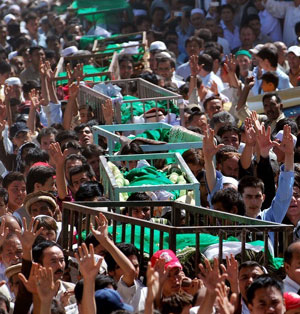
At least 29 Hazara Shias have been killed and scores wounded in Quetta in the last two weeks, in the recent spate of violence against the minority community. Last week, thousands of people gathered in the capital of the Balochistan province to protest against yet another surge in sectarian violence.

The April 13 protests, organized by the Hazara Democratic Party, were called after four people were killed in two separate attacks on Iqbal Road and Abdul Sattar Road in Quetta on April 12.

Holding placards that read 'Stop Hazara killings', 'Say no to terrorism', 'No to sectarianism', and 'We want peace', crowds of protesters, estimated at about 4,000, marched to the Balochistan governor's house late Friday morning.

"I think the security forces and some ministers are supporting the terrorists who slaughter the Hazaras with impunity," Abdul Khaliq Hazara, chairman of the secular ethnic Hazara Democratic Party (HDP), said during a protest rally.

Ahmed Ali Kohzad, general secretary of the HDP, said his party was calling for targeted action by the Pakistani government against the groups responsible in the killings.

Qadir Nayel, a local writer and activist, said that the people had little faith in the local government of Balochistan province.

"We see security personnel only when we come downtown to protest against the massacre of our brothers," said a protester, Juma Khan.

In a statement following the killings of 13 Hazara aboard a bus in the outskirts of Quetta in fall last year, Amnesty International had said "routine targeted killings against the Hazara and other groups because of their ethnicity, religion or political affiliations raises serious questions about the will or ability of Pakistan security force to protect the people of Balochistan".

"I know I will be killed one day for being a Hazara Shia"

Nayel said that the protests in Quetta, along with similar demonstrations in Islamabad, Multan and Muzaffarabad on Friday will get the attention of international human rights groups.

Sajjad, an activist attending the rally, said he could see television cameras but doubted the report would make it to actual broadcasts on mainstream media. Nayel says people in other parts of Pakistan, such as Karachi, have their own issues to deal with. He described their approach to the matter as "largely hands-off".

Many protesters said the perpetrators of the crimes roamed the streets with little fear. "We are sure that the same assailants who killed two Hazaras on Iqbal Road, killed two more in Liaqat bazaar on their way home".

Asked if he feared an attack on the rally, a protester said: "I am not afraid. I know I will be killed one day for being a Hazara Shia anyway."

"We will never resort to violence," said an energetic young man. "We will keep protesting in a civilized manner, unlike the coward terrorists."

The three-hour-long sit-in outside the Governor's House came to an end after the governor and provincial ministers assured the leaders of the HDP they would take up the issue with the chief minister of the province and make a comprehensive plan to end the attacks on the Hazara in Quetta. The protesters then dispersed peacefully.

The HDP also called a wheel-jam strike on April 15 that was supported by all major political parties. Also on April 15, Balochistan Chief Minister Nawab Aslam Raisani met with a Hazara delegation led by Sardar Sa'adat Ali and agreed to launch a targeted operation against terrorists groups.

At least 90 suspects have been arrested so far from various localities of Quetta.

The Balochistan government has also vowed to revisit its security plan and decided to install hundreds of CCTV cameras in various localities in Quetta to improve law and order.

By: Dr. Saleem Javed
Dr Saleem Javed is a freelance journalist based in Quetta. He blogs at http://saleemjavid.wordpress.com/ and tweets at @mSaleemJaved


Source

2 Hazaras killed in Quetta, FC arrests 3 suspects


QUETTA: Targeted killings of Hazara community in the provincial capital continued as two more persons were shot dead on Brewery Road in Quetta on Saturday.
However, Frontier Corps (FC) claimed to have arrested three suspects allegedly involved in the Brewery Road incident and seized arms from their possession.
According to a police officials, two persons were passing on a motorbike on the Brewery road when an unknown person opened fire at them, killing them instantly. They said that the  attackers had managed to escape from the scene after committing the crime.
“A man on foot opened fire at the men on motorbike,” said a local police official Amir Dasti, quoting eyewitness accounts.
He said it was the case of sectarian target killing and investigations were underway.
A heavy contingent of police and security forces reached the spot and shifted the bodies to Bolan Medical Complex where the deceased were identified as Boban Ali and Hussain Ali, inhabitants of Hazara Town.
“The victims were shot in the head and chest,” hospital sources said.
Scores of angry people belonging to Hazara community staged a noisy demonstration on Brewery Road near the hospital. They blocked the road by torching used tires. Protesters raised slogans against the government and law enforcement agencies for their failure to protect the Hazara community from target killers.
Meanwhile, a spokesperson of Frontier Corps (FC) confirmed that the killers of two Hazaras on Brewery Road had been apprehended as FC personnel deputed on the road chased down the criminals who even opened fire at them. “The attackers after targeting two persons of Hazara community tried to escape from the scene. Security forces chased the killers with the help of local people,” he stated in his official press release.
The statement detailed that the FC had first arrested two suspects identified as Guharam Soori Khan and Mian Khan and later booked a third  uspect following disclosure from his colleagues during interrogation.
The arrested suspects were handed over to Brewery police for further interrogation, the FC official said, adding that people present on the spot had also identified the target killers arrested by FC.
Inspector General FC Balochistan Major General Ubaidullah Khan praised the FC and police for acting against the killers on time. “The perpetrators will not escape if local people continue to cooperate with law enforcement agencies,” he said while announcing the arrest of killers.

Two Hazara gunned down in Quetta

QUETTA: An unknown gunman killed two men at Brewery Road, Quetta on Saturday, Geo News reported.


According to police, a gunman opened fire at a motorcycle at Brewery Road that killed one man on the spot while the other was wounded.


The injured was shifted to BMC Hospital for treatment where he succumbed to his injuries. The relatives of the victims reached the hospital and protested the killings.


The attacker fled from the scene while investigations into the incident are underway.


Source

Monday, 16 April 2012

Another Hazara shot dead, six escape separate attack


QUETTA: 
The security plan devised by the Government of Balochistan to target terrorists fanning sectarian violence in Quetta appears to have failed as yet another man belonging to the Hazara community was gunned down in broad daylight on Quarry Road, while six others escaped unhurt in a separate attack on Spinny Road.

Salman Ali, an elderly man, was sitting at a tyre shop when two assailants on a motorbike appeared and shot him in the head and chest. The attackers fled from the scene after the incident. The police reached the site and took the body to Provincial Sandeman Hospital.
Police termed the killing a case of sectarian targeted killing saying the victim was Hazara and a resident of Marriabad, a neighbourhood of the Shia community.
The incident triggered panic and most of the shops and markets on Quarry Road, Prince Road, Mezan Chowk and Liaquat Bazaar were closed.
The police and traffic police deputed in these areas were seen advising the people to go home by saying the situation had gone worse again.
The killing was reported in the heart of the city where a heavy contingent of police, Frontier Corps (FC) and other law enforcement agencies were deployed a few days ago following the targeted killings of six people on Monday.
A few hours earlier, members of the Hazara community in a yellow cab escaped unhurt when a group of armed men opened fire at them on Spinny Road.
“The people were on their way to Marriabad from the Hazara town when they were attacked by armed men. However, the people escaped unhurt in the attack,” Shia Conference stated in its statement to condemn the killings.
“It is ironic that the chief minister chaired a high-level meeting with the participation of high officials of law enforcement agencies and very next day, killing of innocent people resumed,” the Shia leaders said.
A number of Hazara people blocked the highway on Western Bypass to condemn the previous targeted killings. They raised slogans against the government and law enforcement agencies for their failure to break up the chain of target killers.
“The inaction on the part of law enforcement agencies is raising questions on their sincerity to protect the Hazara community,” Muhammad Ali, a young protestor said, adding that the Hazara community is peaceful in Quetta but they are being pushed against the wall.
Angry protestors also burnt tyres at Mezan Chowk and on Alamdar Road to register their protest.

Chief Minister Balochistan Nawab Aslam Raisani returned to Islamabad after chairing a high-level meeting pertaining to the law and order situation in Quetta.
Banned outfit Lashkar-i-Jhangvi (LJ) claimed responsibility for the targeted killings of Hazara community.
The spokesperson of LJ who introduced himself as Ali Shair Haideri told local media in Quetta that his organisation carried out targeted attacks on Quarry Road and Spinny Road. Talking from specified location, he said his organisation will continue its attacks in the future.
By: Shehzad Baloch 

Persecution of Hazara people

Persecution of Hazara people refers to systematic discriminationethnic cleansing and genocide of Hazara people, who are primarily from Hazarajat a central highland region in Afghanistan. Upto half a million Hazara also live in the city of Quetta in neighbouring Pakistan. The persecution of Hazara people dates back to late 19th century during the notorious reign of Emir Abdur Rahman (1880-1901), who killed, expelled and enslaved many thousands. It is believed that at least half of the population of Hazarajat were killed by Abdur Rahman's forces which also resulted in mass exodus of these people to neighbouring Balochistan of British India and Khurasan in Eastern Iran. The persecution continued throughout the 20th century in various forms. Many Hazara were coerced into hiding their identities and surrendering their lands to Pashtun tribes. Hazara people have also been the victims of Massacres by Taliban in Afghanistan since 1995. Although the situation improved relatively in Afghanistan with the ousting of Taliban from power in 2001, hundreds of Hazara have been victimised in Quetta Pakistan, in recent years.

Afghanistan

Hazara people are historically the most restrained ethnic minority and have witnessed slight improvements in the circumstances even with the setup of modern Afghanistan. The discrimination against them was not set off by Taliban in last decades but has subsisted for centuries by Pashtuns and other ethnic groups . Before the 19th century, Hazaras were the prevalent ethnic group in Afghanistan, constituted almost 67% of the population now remains only 2.8 million. More than half was massacred in 1893 during the reign of Abdur Rahman Khan. After which, for centuries, severe political, social and economic tyranny and denial to basic civil rights were faced.


Afshar


The Afshar district home to Hazaras, situated on the slopes of Afshar Mountain in the west of Kabul, was a densely peopled neighborhood where the operation took place. In February 1993, a military operation was conducted by Burhanuddin Rabbani's Islamic State of Afghanistan government forces to capture the positions of Hizbe Wahdat and capture Abdul Ali Mazari.
Abdul Rasul Sayyaf's Ittihad was greatly involved in the operation which was allied with the Rabbani government. Ittahid rampaged all the way through Afshar, slaughtering, raping and burning houses. Around 70 people died during the street fighting and between 700-750 persons were abducted, who never retunred, by Sayyaf’s Ittihad and were most likely killed or died in captivity. Tens of women were abducted as well during the operation. Some sources put the total number of deaths between 4000 and 8000.

Robatak Pass

The pass connecting the settlements of Tashkurgan and Pule Khumri is well-known as Robatak Pass where a mass murder was carried out by Taliban in May 2000 in which 31 confirmed dead was reported. Twently-six of the victims were Ismaili Hazara from Baghalan province their remains were found to the northeast of the pass, neighborhood famous as Hazara Mazari, the border between Baghlan and Samngan provinces. The victims were detained four months before their execution by Taliban troops between January 5 and January 14, 2000.

Yakawlang

In January 2001, Taliban committed a mass execution of Hazara people in Yakawlang District of Bamyan province, Afghanistan. The Human butchery started on January 8 and lasted for four days which took lives of 170 men. Taliban apprehended about 300 persons, together with employees of local humanitarian organizations then they were grouped to various assemblage points where they were shot dead in public view. Around 73 women, children and elderly were taking shelter in a local mosque when Taliban fired rockets at the mosque.

Pakistan

About half a million Hazara live in Quetta, who fled persecution in neighbouring Afghanistan during the 19th century. Majority of the Hazara is Shiite Muslim with sizable Sunni minority. Although sectarian violence in Pakistan, with an estimated 20% Shia Muslim population, started during the reign of military dictator General Zia-ul-Haq in the 1980s, the Hazara community in Quetta had never been involved in this conflict. Notable Hazara individuals include Qazi Mohammad Isa, General Muhammad Musa, Air Marshal (R) Sharbat Ali Changezi, Abrar Hussain Shah, Hussain Ali Yousafi, Abdul Khaliq Hazara, Dr. Ruqaya Hashemi, MNA Nasir Ali Shah, MPA Jan Ali Changezi and Sardar Sa'adat Ali. Hazara Democratic Party is a secular nationalist party with liberal democratic ideology which represents the Hazara people in Pakistan.


Casualties

Around 700 community members including doctors, lawyers, teachers, engineers, intellectuals and other professionals have lost their lives and at least 1500 have been injured as a result of violence against Hazara people in Quetta in recent years. One third of the victims are children. No one has yet been arrested for these cold blooded murders.


Perpetrators

It is widely assumed that Pakistani Sunni extremist militant group Lashkar-e-Jhangvi, (an Al-Qaida and Taliban affiliate), is behind these attacks. However, some Hazara believe that the perpetrators can not possibly be operating independently. Another theory suggests the involvement of Taliban, whoes leadership council known as the Quetta Shura is established and operates in the city of Quetta. Taliban carried out several massacres inside Afghanistan between 1995-2001, which cost the Hazara people at least 10000 lives. Lashkar-e-Jhangvi is believed to be one of the many Pakistani terrorist groups which fought for Taliban against the United Front in Afghanistan. The most common perception regarding Hazara people's resentment towards the Taliban is based on ethnic and religious differences. The Hazara however, add one crucial disagreement with the Taliban on grounds of their socio-political ideology. The Hazara assert that the Taliban is an extremist ideology of violence, terror, intolerance and religious fanaticism, whereas the Hazara people strongly adhere to the principles of Human Rights, Democracy, Tolerance, Pluralism, Inclusiveness, and Equal opportuniy for all. Most of the terrorist organizations in Pakistan are allegedly supported by the country's military establishment. It is also suggested that the country's security establishment might be trying to provoke the Hazara against other ethnic groups in the province. Asian Human Rights Commission reported in January 2012 that the Pakistan army had created a militant organization to kill intellectuals, activists and Hazaras in Balochistan.


Response

In response to the latest surge in violence, the Hazara people have requested nations all around the world to stage protest demonstrations against their systematic genocide. They have also requested free peoples of the world to write letters to their governments asking them to pressurize the Pakistani government and military to arrest the killers and ensure their safety. The persecution or genocide carried out against the Hazara has been documented by the United Nations,Amnesty International, Human Rights Watch, Asian Human Rights Commission, Human Rights Commission of Pakistan and Afghanistan Independent Human Rights Commission. EU parliamentarian Rita Borsellino has urged the international community to address the plight of Hazara people in Quetta.  British Parliament has also asked the government to pressurize Pakistani authorities for absence of Justice with Hazara community in Pakistan. Parliamentary Under Secretary of State for South Asia/counter terrorism, Alistair Burt, said, I acknowledge to terrifying statistics about the absence of justice...we remain very concerned about the response of the Pakistani authorities to those statistics, and we will apply pressure in relation to them. Mark Lancaster, MP from Milton Keynes North, said, ... while that statistic of more than 600 deaths and not a single conviction, it is very hard to take seriously the Pakistan's claim that they are tackling this matter? Alan Johnson, MP From Kingston upon Hull West and Hessle said, the Pakistani Government must do more to root out state-supported terrorism wherever it exists. It undoubtedly exists in Quetta city, and the Hazaras are its principal victims. It is a good place to begin this process. Iain Stewart, MP from Milton Keynes South said that he endorsed all the points made by the MPs and added, those attacks are not being dealt with appropriately by the authorities in Pakistan. Responding to a journalist's question regarding the Mastung Massacre, Aslam Raisani the chief minister of Balochistan said, The population of Balochistan is in millions, 40 dead in Mastung, is no big deal. When asked about what he could do for the grieving families of the victims, he replied, I can send truckload of tissue paper for them to wipe their tears. The Pakistani Army and its notorious intelligence wing, the ISI have accused foreign interference in Balochistan's affairs, without directly responding to allegations against themselves for allowing the banned terrorist organizations to operate freely and with complete impunity. Despite several meetings held by local Hazara elders with the Army Corps Commander Quetta, the military has not taken any action against the culprits to this date. Mahmood Khan Achakzai, and Sardar Akhtar Mengal, the exiled Baloch leader have also condemned the killings demanding that the Pakistani security establishment take stern action against those involved in terrorism and acts of violence against civilians. In his reaction on March 29, 2012, Sardar Akhtar Mengal accused the Pakistani military establishment of trying to sow hatred and division among the oppressed peoples by promoting religious extremism and intolerance, which his people regarded against their traditions. The community's response to these attacks has been limited to civil protests only. The Hazara diaspora in Australia, Western Europe and North America have also joined these protests from time to time. Haji Mohammad Mohaqiq the political leader of the Hazara in Afghanistan has also expressed solidarity with the Hazara community in Quetta. The Hazara in Afghanistan and the Hazara diaspora all around the world have organized and coordinating efforts to raise awareness internationally about what the Hazaras are going through. Hazara People International Network is one example of this effort. Hazara children cannot go to schools and adults cannot go to their work without risking their lives. Many Hazara want an immediate intervention by the international community in any form. They express angrily why the international community namely, the EU, UN, Australia or the US, are not raising the issue of ongoing massacre of Hazara people with the Pakistani state.


Timeline of major attacks

2001

February 09: Six passengers were shot dead and five severely wounded when they were traveling in a van en route from Hazara Town to Alamdar road. Unidentified gunmen opened fire. Later, Lashakar-e-Jhangvi claimed responsibility for the attack.


2003

June 08: Eleven Police cadets belonging to Hazara ethnic minority were killed, when two assailants opened fire on their vehicle. The attack occurred on Saryab road which also left 9 others injured.
July 04: Forty seven were killed in an attack on the worshippers during Friday prayers, when three gunmen entered a local mosque, threw grenades and opened fire. 65 people were also injured.


2004

March 02: Forty two people were killed and at least 150 injured on the holy day of Ashura, when the faithful were mourning the death of Imam Hussain, Prophet Mohammad's grandson, in the battle of Karbala. After an explosion the terrorists opened fire on the procession.


2009

January 26: Hussain Ali Yousafi, chairman Hazara Democratic Party was gunned down by unidentified assailants in brought day light. Police has not been able to arrest anyone involved in his assasination.


2010

Some 100 people from Hazara minority lost their lives in several incidents of targetted killings in 2010 alone and many more were wounded.


2011

May 06: Eight died and fifteen wounded in the early morning when armed men fired rockets at Hazara people playing outside in an open field. Children were also among the victims.
August 31: Thirteen died and twenty two wounded when a suicide bomber blew himself in the morning of Eid near Hazara Eid Gah. Four women and two children were also among the dead.
September 20: A bus carrying Hazara pilgrims was stopped in Mastung near Quetta. Called the Mastung Massacre, armed gunmen entered the bus and after identifying Hazara passengers, pulled them out, lined up and sprayed with bullets in summary execution style. At least twenty six died on the spot. Later, on the same day, relatives of the victimes who were on their way to collect the dead bodies of their loved ones from the scene, were also fired upon by unidentified terrorists killing 3 and injuring many more.
September 23: Five more Shia Hazara were the casualties of yet another attack just three days after the Mastung massacre, when unidentified gunmen opened fire on a van.
October 04: Thirteen Hazara vegetable vendors were among the fourteen victims when unidentified gunmen targeted a van carrying them in Quetta.


2012

January 26: Three Hazara men were shot dead, Two of the victims were public servants , the third was a television artist.
March 26: Two Hazara men were shot dead in Sabzal road.
March 29: A taxi carrying passengers from Hazara Town was sprayed with bullets which killed seven and injured six. Three women and some children were also among the casualties. This had been the third attack on this small community in just one week. Two boys aged under 16, were shot dead later by the police as they tried to disperse angry protesters who were trying to block the road for traffic, raising the death toll to nine. People were especially furious as the attack had occured just 15 meters from the police check post. Police has arrested three protesters including the brother of a dead victim.
April 03: Two more Hazara were shot dead in Mekongi road Quetta on Tuesday 3 April 2012 when they were busy working in a metal welding shop.
April 09: In a cold blooded attack on Hazara people in Quetta, at least six men including a 16 year old boy, lost their lives when gunmen opened fire at shoe makers in a shop on Prince road Quetta. A 17 year old student protester was shot dead by the police the next day.
April 12: Three Hazara shopkeepers were shot dead in Quetta and one other person was critically injured on Thursday April 12, 2012.
April 13: Two people, including a woman, were shot dead by armed assailants. The victims belonged to the Hazara ethnic minority in Quetta Pakistan.
April 14: Eight Hazara men were killed this morning on their way to work when armed assailant opened fire at a taxi carrying them on Brewery road.


Sunday, 15 April 2012

"عادی پنداری تراژدی کویته؛ فرار از مسوولیت حقوقی "نسل کشی

توسط: هادی صادقی
کشتار سیستماتیک و هدفمند هزاره ها در کویته پاکستان این روزها شدت گرفته است. تنها در دو هفته اخیر، بیست و پنج نفر کشته و چندین تن دیگر زخمی شده اند. شهروندان کویته از چند روز بدینسو در تحصن به سر می برند و موجی از اعتراضات مدنی در پاکستان و کشورهای مختلف جهان براه افتاده اند.
اعتراضات مدنی هم هنوز کاری از پیش نبرده، حملات مسلحانه همچنان بر مردمان ملکی و بی گناه در کویته ادامه دارد و جنایت روز بروز ابعاد بیشتری به خود می گیرد؛ اما هنوز دولت پاکستان هیچ اقدامی نکرده و جامعه جهانی، نهادهای دفاع از حقوق بشر و رسانه های جهان در قبال این نسل کشی بی شرمانه سکوت کرده اند.
حکومت ایالتی سرحد، در برابر این فاجعه، تنها کاری که توانسته، با ریختاندن هزاران سرباز پولیس و ارتش در محلات هزاره نشین، مردم را در خانه های شان محصور کرده تا آنان را از اعتراضات مدنی باز داشته باشند، در حالیکه روند جنایت و کشتار همچنان و بلکه شدید تر از پیش ادامه دارد.
تعصب کور نسبت به هزاره ها از سال های پیش در میان حلقات و جریان متعصب و افراطی در پاکستان وجود داشت، اما اخیرا این ذهنیت از سوی هسته ها و گروه های تروریستی و بنیادگرا مورد استفاده و تبلیغ قرار گرفته و به ابزاری برای آشوب و گسترش خشونت در پاکستان تبدیل شده است.
لشکر جنگوی، سپاه صحابه و برخی دیگر گروه های افراطی، ایده دشمنی با هزاره ها را در میان مردم تبلیغ کرده و کشتار هزاره ها را سرلوحه کار شان قرار داده اند. این روند در دو سال اخیر تشدید یافته و تنها در سال گذشته بیش از 150 تن از شهروندان ملکی هزاره پاکستان از سوی افراد ناشناس کشته و ده ها تن دیگر زخمی گردیدند.
تاهنوز حکومت پاکستان سیاستی مسوولانه ای در قبال این فاجعه اتخاذ نکرده است؛ حکومت پاکستان همواره با عادی پنداری این رویداد ها و بی اعتنایی نسبت به آن، تلاش کرده کشتار سیستماتیک هزاره ها را در شمار رویداد های جنایی عادی و یا اعمال تروریستی تلقی کرده و از این طریق در افکار عمومی جهان و مجامع دادرسی بین المللی، از زیر بار مسوولیت حقوقی سنگین "نسل کشی" در قلمروش، فرار نماید.
جامعه جهانی و خصوصا نهادهای دفاع از حقوق بشر متاسفانه در قبال این فاجعه سکوت کرده اند و حکومت پاکستان را در برابر "نسل کشی" ای که در قلمروش اتفاق می افتد، مورد بازخواست بین المللی قرار نداده است. بدون تردید، کشتار سیستماتیک هزاره ها در کویته پاکستان، نه رویداد های جنایی عادی و نه در شمار حوادث تروریستی است که امروزه در افغانستان و پاکستان هر روز اتفاق می افتد؛ بلکه یک "نسل کشی" آشکاری است که در قرن بیست و یک و تحت حاکمیت حقوق بشر جهانی اتفاق می افتد.
دولت پاکستان در ارتباط با این جنایت ها مسوولیت های سنگینی به عهده دارد. اولا این که حکومت پاکستان ملزم به دفاع از شهروندانش می باشد، دوم اینکه در ارتباط با وقوع "نسل کشی" در قلمروش در مجامع و دادگاه های بین المللی باید پاسخگو باشد؛ سوم این که، ادامه این روند، پاکستان را به جنگ داخلی کشانده و این کشور را به بحران های سیاسی و امنیتی بزرگی فرو خواهد برد. 

هزاره های کویته، چاره اندیشی در برابر تروریسم


توسط: محمد امین میرزاد

روز جمعه هفته گذشته مردم هزاره کویته پاکستان در اعتراض به کشتار و جنوساید قومی هزاره ها دست به اعتراض و تظاهرات گسترده در مقابل ساختمان گورنر و وزیراعلی ایالت بلوچستان پاکستان زدند. مرکز تجمع درعلمدار رود(خیابان) بود و از آنجا راهپیمایان حرکت شانرا به طرف گورنرهاوس ( خانه حاکم ایالتی) که در مرکز شهر واقع است، شروع کردند.
در حالی که سایه ترس و وحشت از ترورها و کشتارهزاره ها سراسر کویته را فرا گرفته بود، بازهم هزاره ها با نادیده گرفتن همه خطرات و احتمال حملات انتحاری و تروریستی، دست به راه پیمایی بزرگ تاریخی زدند. در طول راه شعارهای مختلفی را سردادند، اما درمقابل اداره ایالتی بلوچستان به یاد شهدای مظلوم تروریستی کویته سکوت کردند.
آقای مگسی حاکم ایالتی بلوچستان دردیدار بانمایندگان هزاره جز تاسف دستآورد دیگری نداشت و فقط گفته است که وزیراعلی بلوچستان باید به صورت فوری کریک داون (عملیات هدفمند) بر ضد تروریستان را شروع کند. اما این کریک داونی که مثل توپ فوتبال مقامات ایالت بلوچستان به یک دیگر پاس می دهند، کی شروع خواهد شد، خدا می داند و تازه معلوم نیست با وضعی که در کویته وجود دارد، چنین کریک داون هایی اصلا تاثیردارد یا خیر و می تواند تروریستی را بکشد و یا زنده دستگیر نماید؟.
در سال گذشته نیز از این گونه کریک داون ها زیاد شد اما حتی یک نفر هم از تروریست ها نه کشته شدند و نه دستگیر. اما در سال جاری که تنها دردوهفته اخیر 25 نفر از مردم هزاره به شهادت رسیده اند، تازه دستورچنین کریک داونی را حاکم اعلی به وزیر اعلی داده وزیر اعلی هم باید دستور آن را به پولیس بدهد و نیروهای پولیس هم همان کسانی هستند که در جلو چشمان شان تروریست ها چندین نفر را در یک موتر به شهادت رساندند.
تظاهرکنندگان قطعنامه 5 ماده ای را تنظیم کرده بودند که در آن خواهان توجه بیشتر پولیس به امنیت هزاره های کویته شده بودند و نیز خواهان برکناری افراد مشکوک از داخل پولیس شده بودند و از تمام سازمانهای داخلی و بین المللی، دادگاه عالی کشور و رسانه ها خواهشمندیم تا سکوت ننموده وظیفه شانرا در قبال مردم بی گناه ما انجام دهند.
تروریست ها بسیارزود جواب این اعتراضات را دادند، فردای آن روز شنبه تروریست ها در چند حمله جداگانه 9 تن دیگر از مردم هزاره را به شهدات رساندند. این حوادث در حالی صورت گرفت که عملیات هدف مند یا همان کریک داون در کویته شروع شده بود و کویته تحت پلان امنیتی شدید قرار داشت اما این کریک داون هم مانع کشتار مردم بی دفاع و دست خالی کویته نشد.
در طی ادامه این کشتار سردار سعادت علی هزاره خواهان برقراری فوری حکومت نظامی در بلوچستان برای جلوگیری از حادثه کشتار هزاره های کویته شده است. این که آیا در سایه حکومت نظامی هم می تواند جلو کشتار تررویست ها را بگیرد هنوز روشن نیست زیرا در کویته وضعیت طوری است که اهداف و خواسته های تررویست ها همه گنگ و مبهم است و تنها چیزی که در آن آشکار است گشته شدن هزاره ها در عملیات های منظم تروریستی است.
هرچند مقامات پاکستانی بارها اعلام کرده اند که جلو حملات تروریستی و فعالیت های افراطی گری را نمی توانند در پاکستان بگیرند، اما در این واقعیت جای تردیدی باقی نمی گذارد که مقامات امنیتی پاکستان اعم از پولیس، اردو و نیروهای امنیتی این کشور به مراتب قوی تر و سازمان یافته تر وبا تجربه ترازافغانستان است، حال سئوال این است که آیا این نیروها نمی توانند و قادرنیستند جلو حملات تروریست ها را در کویته بگیرند؟.
آیا این انفعال را به نوعی بی توجهی مقامات امنیتی پاکستان به حساب آورد یا نشانه ضعف و ناتوانی این نیروها است؟.
آیا در طول دو سالی که کشتار هزاره ها در کویته پاکستان شروع شده است و تاکنون چندین حمله تررویستی صورت گرفته است، آیا در هیچ یک از این حوادث نیروهای پولیس، اردو و سرویس های اطلاعاتی پاکستان قادر نبوده اند حتی یک تن از تررویست ها را شناسایی و دستگیر و یا بکشند؟.
در حالی سرویس اطلاعاتی پاکستان از مهمترین و زبنده ترین سرویس های اطلاعاتی جهان به شمار می رود اما چگونه است که این سرویس حتی قادر نیست یک نفر از تروریست ها را شناسایی کنند و یا عملیات های تررویستی آنها را خنثی کند؟.
باتوجه به این سئوالات بی پاسخ است که جنایات خونین تروریستی را در معمای گنگ و مبهم فروبرده است. نیروهای امنیتی پاکستان بارها اعلام کرده است که در برابر هر حادثه ای ممکن است انعطاف نشان دهد اما در برابر حوادثی که امنیت و ثبات و وحدت ملی را در پاکستان خدشه دار می کند، هرگز مسامحه نمی کند، اما حال سئوال این است که تکرار جنایات زنجیره ای هزاره ها طی دوسال اخیر چالش های امنیتی به وجود نمی آورد؟.
آیا کشتار زنجیره ای هزاره ها سبب لطمه خوردن به وحدت ملی و همزیستی اقوام ساکن در پاکستان نخواهد شد؟. در چنین وضعیتی چرا نیروهای امنیتی و سرویس های اطلاعاتی پاکستان برای دستگیری و مجازات عاملات جنایت های زنجیره ای کویته هیچ اقدام جدی نمی کنند؟.
باتوجه به وضعیتی که درکویته پاکستان حاکم است، به نظر این قلم تنها دست به تظاهرات زدن تحصن راه بجایی نمی برد، جالب این است که هزاره های کویته منطقی را در برابر تروریست ها در پیش گرفته اند که تروریست ها هرگز نمی فهمند و اعتراض و تظاهرات برای آنان هیچ مفهومی ندارد.
اعتراضات هزاره های کویته هیچ مفهومی برای تروریست ها ندارد. حال در برابر چنین مطقی چه باید کرد؟ اعتراض بهترین راه مبارزه و رسیدن به خواسته ها است، اما در کنار این اعتراضات مردم کویته باید هوشیاری خود را حفظ بکند و به دنبال راهکارهای تاثیر گذارباشند.

راههای که بتواند تهاجم تروریست ها را سد بکند، این که این روش ها و راهکارها چه است، باید روی آن اندیشه و مشوره صورت گیرد، باید نقاط ضعف تروریست ها شناسایی شده و از این طریق فشار وارد گردد. هزاره باتوجه به عملکرد دولت های محلی بلوچستان و نیز مرکزی چندان امیدی از سوی این نهاد ها نباید داشته باشند، زیرا اگر این دونهاد برای جلوگیری از فعالیت های تروریستی علیه هزاره ها کاری می کرد، تا حالا کرده بود

Complete strike observed in Quetta


By: Shehzad Baloch


QUETTA: 
A complete shutter down and wheel-jam strike was observed in the provincial capital, paralysing the business activities on Sunday.
Stringent security measures were taken to maintain law and order, with the deployment of paramilitary troops Frontier Corps (FC), police and other law enforcing agencies in and around Quetta.
The strike was called by the Hazara Democratic Party (HDP) and was backed by the Balochistan National Party (BNP) and Jamiat-i-Ulema Islam-Fazal (JUI-F) to protest against the recent wave of sectarian targeted killings that left 18 killed in the last four days.
All the shops, markets, eateries and even chemists shops in Liaquat Bazar, Mezan Chowk, Abdul Sattar Road, Prince Road, Jinnah Road, Zarghoon Road, Brewery Road, Hazara Town and Marriabad remained closed.
The strike was observed partially in Saryab and the nearby areas as markets and shops were functional as usual.
It is pertinent to mention that half of the business community in Quetta observe weekly holiday on Friday while remaining shut their businesses on Sunday.
Police and security forces also booked over 200 people for violating the ban on pillion riding in the city.
Security personnel increased their patrolling in Quetta to restore order. However, panic and fear continued to plague the city as people preferred to stay indoors and most of the streets and roads presented a deserted look, with very thin traffic plying on the roads.
Chief Minister Nawab Aslam Raisani presided over a high level meeting to review the law and order situation in the aftermath of targeted killings of Hazara community members.
Provincial Ministers, Inspector General Police (IG) Balochistan, Home Secretary and other senior officials attended the meeting, which was convened to devise a strategy to deal with the situation. The meeting was underway when this report was filed.
The HDP Chief Abdul Khaliq Hazara in his statement said his community was being compelled to pick up arms to protect its members from the targeted attacks.
Source